Kde koupit
Potřebujete poradit? Naši vysoce kvalifikovaní prodejci vám rádi pomohou s malými i velkými dotazy.
Najděte prodejce ve svém okolí

Upgrading your RV Battery Bank from Lead-Acid to Lithium

For those who love the freedom of RV travel, switching from lead-acid batteries to lithium will improve your experience, keep you off the grid longer, and give you more time enjoying the outdoors instead of worrying about your batteries.
This article explains why upgrading to lithium is one of the best improvements you can make to your RV's electrical system. It also helps you determine the right battery capacity for your needs, evaluate your existing charging system, identify any components that need to be upgraded, and avoid common mistakes that can add unnecessary cost or reduce system performance.
Whether you're a weekend camper, a seasonal traveler, or a full-time RVer, upgrading to lithium can significantly improve your RV's electrical systems performance. Even if you're simply replacing an aging lead-acid battery bank, converting to lithium provides faster charging, more usable power, longer battery life, and a more reliable off-grid experience.
Charge Faster
Lithium batteries can accept much higher charging currents than lead-acid batteries. For example, a typical 100 Ah lead-acid battery may only accept about 20–30 amps during bulk charging, while a 100 Ah LiFePO₄ battery can often accept 50–100 amps, depending on the manufacturer's specifications. Combined with lithium's much flatter charging curve, this allows the battery to recharge significantly faster and get you back on the road sooner.
More Usable Power
Lithium batteries can safely use up to 100% of their rated capacity, while lead-acid batteries should generally only be discharged to about 50%. This gives you substantially more usable power from the same battery bank.
Longer Life
Quality LiFePO₄ batteries typically last 3,000 to 6,000 charge cycles, compared to only a few hundred to around 1,000 cycles for most lead-acid batteries. In real-world use, that often translates to a service life of about 10 or more years for a quality lithium battery, compared with roughly 3 to 5 years for a typical lead-acid battery, depending on how the batteries are used and maintained. Their longer service life can make lithium a better long-term investment for RV owners.
Maintenance-Free
While sealed lead-acid batteries such as AGM and gel are also essentially maintenance-free, LiFePO₄ batteries provide additional benefits, including greater usable capacity and longer service life.
Less Weight
Lithium batteries typically weigh 30% to 60% less than comparable lead-acid batteries, depending on the battery type and capacity. For example, a typical 100 Ah flooded lead-acid battery weighs around 60–70 pounds (27–32 kg), while a 100 Ah LiFePO₄ battery often weighs only 25–35 pounds (11–16 kg).
The reduced weight can improve fuel efficiency, increase available payload for water and gear, and make batteries much easier to install and handle.
Weight savings are one of the reasons LiFePO₄ batteries have become the preferred choice for many applications, from RVs and campervans to boats and other weight-sensitive systems.
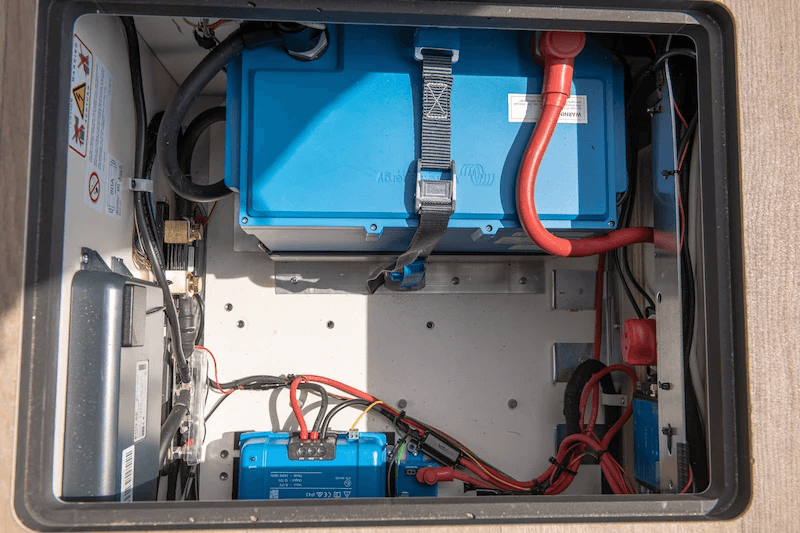
Not all lithium batteries are the same. The type used in most RVs is Lithium Iron Phosphate (LiFePO₄), which is one of several lithium-ion battery chemistries. Other lithium-ion chemistries, such as Lithium Cobalt Oxide (LCO), Nickel Manganese Cobalt (NMC), and Nickel Cobalt Aluminum (NCA), are commonly used in smartphones, laptops, power tools, and many electric vehicles because they offer higher energy density.
However, LiFePO₄ has become the preferred choice for RVs, marine applications, and off-grid energy systems because it offers excellent safety, exceptional cycle life, outstanding thermal stability, and the ability to withstand thousands of deep charge and discharge cycles.
For many RV owners, LiFePO₄ batteries offer significant advantages in usable capacity, charging speed, weight, and service life. However, they may not be the right solution for every application. If you're a weekend camper with modest power needs and a limited budget, a quality AGM battery may still be a practical and cost-effective choice.
AGM batteries also perform well in cold conditions, while LiFePO₄ batteries generally require battery heating or a battery management system (BMS) with low-temperature charging protection to safely charge in freezing temperatures. The best battery choice depends on your budget, camping style, climate, and power requirements.
Before replacing your lead-acid batteries with lithium batteries, it's important to understand how your existing battery bank is charged. Most RVs use one or more of three charging methods:
An AC RV electrical system is designed to operate primarily from residential and campground shore power—typically 120 V in North America and 230 V in Europe and many other regions—or from the RV's onboard generator.
How to Upgrade an AC System to Lithium Batteries
If you plan to continue relying on shore power or generator power, the conversion is usually straightforward. Before installing LiFePO₄ batteries, verify that your converter/charger is compatible with lithium batteries or can be programmed with the correct charging profile. Also confirm that the charger is properly sized for your battery bank and that any inverter/charger is configured using the manufacturer's recommended lithium charging settings.
The vehicle alternator charges the RV's battery bank while the engine is running, allowing the batteries to recharge as you drive.
How to Upgrade an Alternator System for Lithium Batteries
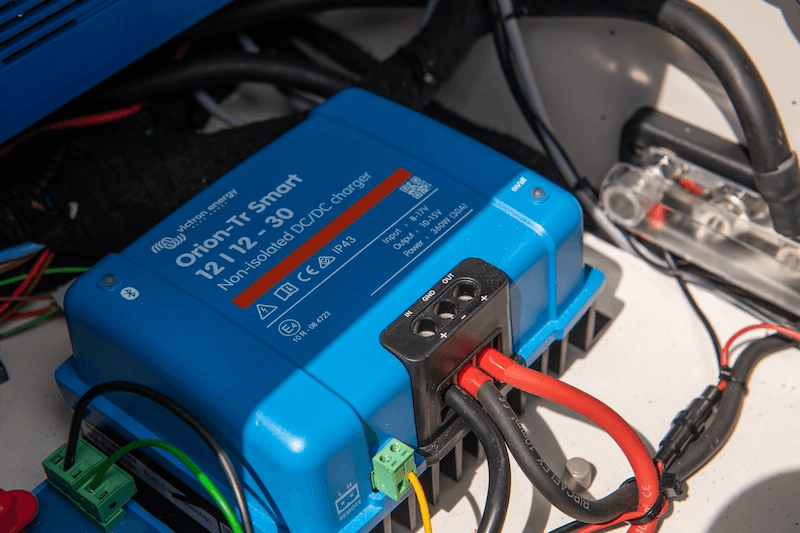
When upgrading an alternator charging system from lead-acid to LiFePO₄ batteries, verify that your charging system is compatible with your new battery bank before installation. In most cases, this means installing a DC-to-DC charger between the alternator and the lithium battery bank, replacing any voltage-sensitive relay (VSR) if your system uses one, configuring the charger with the correct LiFePO₄ charging profile, and verifying that the alternator, charging cables, fuses, and circuit breakers are properly sized for the charging system. Finally, choose a DC-to-DC charger that matches your alternator type, desired charging current, and battery bank capacity.
For instance, our Orion XS Charger is a very comprehensive DC-to-DC charger suitable for RVs that comes in different power ratings.
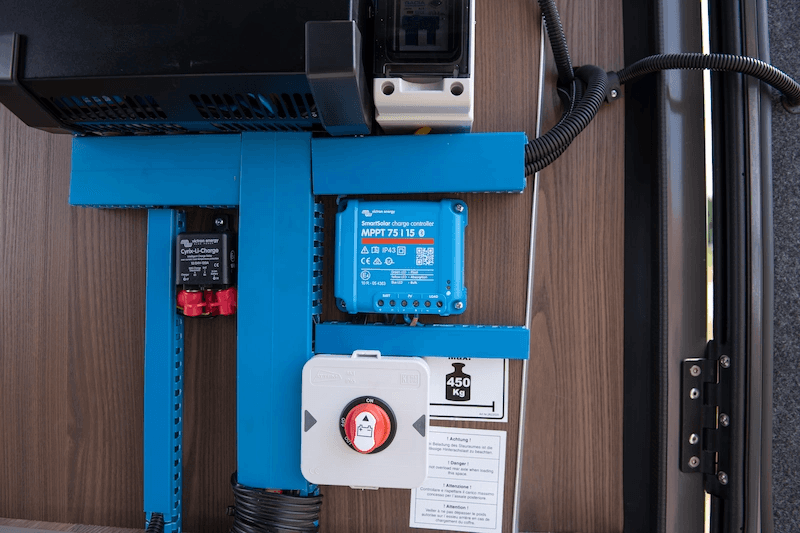
A solar charging system uses rooftop solar panels and a solar charge controller to convert sunlight into electricity and recharge the battery bank.
How to Upgrade a Solar Charging System to Lithium Batteries
If your RV uses solar power to charge the battery bank, verify that the charging system is compatible with LiFePO₄ batteries before installing them. Most modern MPPT charge controllers can be reconfigured for lithium charging, while some older controllers may need to be replaced.
Before installing LiFePO₄ batteries, verify that your solar charge controller supports lithium charging and is configured with the correct LiFePO₄ charging profile. If the controller is compatible, reconfigure it using the manufacturer's recommended settings. If it is not compatible, replace it before installing the new battery bank. For most RV solar systems, an MPPT (Maximum Power Point Tracking) charge controller is the preferred choice because it provides higher efficiency and better overall solar performance.
MPPT charge controllers are more efficient than older PWM (Pulse Width Modulation) controllers and can harvest more energy from your solar panels, especially during cool temperatures, partial shading, and low-light conditions.
Choosing the right battery capacity is an important decision when upgrading from lead-acid to lithium. Although the amp-hour rating may appear the same, LiFePO₄ batteries provide much more usable energy because they can be safely discharged to a much lower state of charge than lead-acid batteries, which are generally limited to about 50% depth of discharge.
For example, a 200 amp-hour lead-acid battery bank typically provides only about 100 amp-hours of usable capacity because it should generally not be discharged below 50%. In contrast, a 200 amp-hour LiFePO₄ battery bank can provide nearly its full rated capacity, giving you almost twice the usable energy from the same amp-hour rating.
When selecting a lithium battery bank, consider how much power you use each day, the appliances you want to run, and how long you plan to camp off-grid. A properly sized lithium battery bank can often deliver the same or better real-world performance than a much larger lead-acid battery bank while taking up less space, weighing less, and charging much faster
Lithium batteries maintain a fairly consistent voltage throughout most of their discharge cycle. Because the voltage changes very little until the battery is nearly depleted, voltage alone is not a reliable indicator of the battery's remaining capacity.
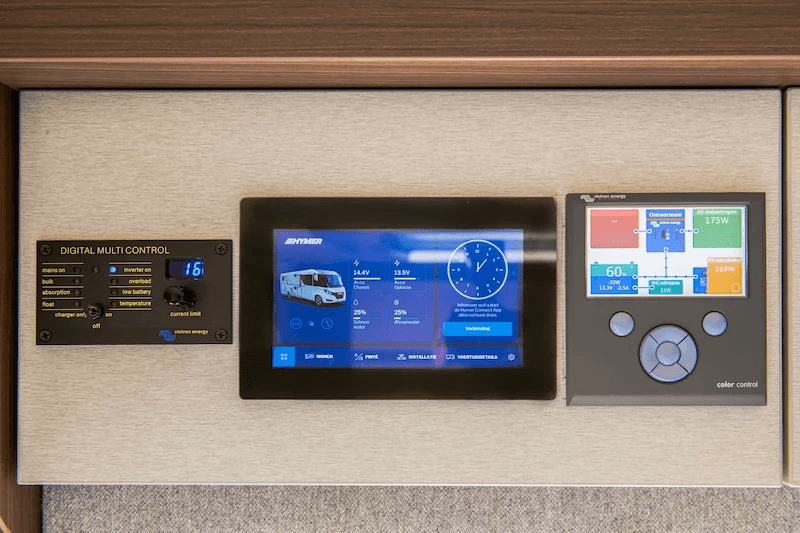
Lead-acid batteries behave differently. Their voltage drops steadily as they discharge, making voltage a much more useful indicator of their state of charge. This difference is why a Victron battery monitoring system is especially important for lithium battery banks—it provides an accurate picture of the battery's true state of charge rather than relying on voltage alone.
A quality battery monitor provides real-time information about how much energy you're using, the power flowing into and out of your battery bank, and how much battery capacity remains. This information helps you manage your electrical system more efficiently and avoid unexpectedly depleting your batteries.
The cost of upgrading to lithium batteries depends on more than just the batteries themselves. Depending on your existing electrical system, you may also need additional components to complete the conversion safely and reliably.
Common upgrade costs may include:
These additional components can add several hundred dollars—or more, depending on your system—to the overall cost of the upgrade. Before purchasing lithium batteries, evaluate your existing electrical system so you can budget for the complete conversion rather than the batteries alone.
Upgrading an RV to lithium batteries is a significant investment. Careful planning before purchasing components can help you avoid costly mistakes and ensure your electrical system performs as expected.
Common mistakes when upgrading to lithium include:
Addressing these items before installation helps ensure a safe, reliable, and long-lasting system.
Taking the time to properly design your system before purchasing components will save both time and money while improving the overall reliability of your RV electrical system. Understanding how the chassis, and house battery systems work together is also an important part of a successful lithium upgrade.
LiFePO₄ (lithium iron phosphate) batteries are widely considered among the safest lithium battery chemistries available. Compared to many other lithium-ion batteries, they are more thermally and chemically stable, making them far less susceptible to overheating or thermal runaway when properly designed, installed, and protected by a quality Battery Management System (BMS). For safe, reliable performance, choose batteries from reputable manufacturers and always follow the manufacturer's installation, charging, and operating guidelines.
While lithium batteries require a higher initial investment, their longer lifespan, greater usable capacity, faster charging, and lighter weight make them an excellent long-term upgrade for many RV owners. A successful conversion also requires compatible charging equipment, including your converter/charger, alternator charging system, and solar charging system. If you camp in freezing conditions, be sure your battery system includes appropriate low-temperature charging protection. By carefully planning your upgrade and selecting compatible components, you can build a reliable electrical system that matches your camping style and power needs.
With freedom comes adventure. With adventure comes memories that can last a lifetime—all powered by sunshine and your new lithium batteries.

Beril Berkem • 04 May 2026
How to size a solar system for your RV
Learn how to size a solar system for your RV. Estimate your energy needs and choose the right components to power your adventures.
Beril Berkem • 16 June 2026
How much does an RV solar system cost?
Get a feeling for the cost of an RV solar system and its components through some helpful examples and tips.Potřebujete poradit? Naši vysoce kvalifikovaní prodejci vám rádi pomohou s malými i velkými dotazy.
Najděte prodejce ve svém okolí
Podívejte se na naše zdroje podpory nebo se obraťte na svého původního prodejce pro zajištění odborné podpory, provedení opravy či uplatnění záruky.
Podpora
Přečtěte si více o naší špičkové 5leté záruce a celosvětovém servisním zázemí.
Záruka


©Victron Energy 2026